Tag Archives: worry

Take Me Over

I decide to open up to a fellow holistic therapist about how I’m feeling. I tell her that nothing necessarily bad is happening to cause this feeling but that I sense its heaviness.

I’m choosing to carry it around and I’m not letting it go. I admit that I’m afraid, which makes me want to close down and not care in order to protect myself.

My friend instructs me to close my eyes and really get into the feeling of being scared. She tells me to allow it to grow and expand and fill my body.

I feel an energy in my chest and my stomach. It feels like fear then anger and then I relax. I open my eyes and relay this to her.

She asks if there’s any bad feeling left. I tell her there is. Sadness and grief. So I’m told to repeat the process of feeling and allowing the sadness.

I see the little girl inside of me. I feel what she’s feeling. But there’s a resistance within me. I don’t particularly want to go there now. Been there, done that.

Despite my current resistance, this year I’ve been loving myself more. When I feel bad, I remember not to reject myself. Because of this major personal breakthrough, I know that I’ll be okay.

My friend tells me that I’m repeating an old pattern. There really is nothing to be afraid of. I need to face my fear so that I can see that it’s just an illusion.

I already feel much better. This makes so much sense. I usually resist these bad feelings, fearing that they will control my life and affect how I behave, react and relate to others.

My friend reminds me that this is where my resistance lies. I don’t want these feelings. I’m trying to avoid certain behaviours. And I’m fearing the worst possible outcome.

“Stop resisting,” my friend insists.

“Allow the feeling to take you over. That will create a shift. A letting go. Which will open you up in wonderful ways.

Open your heart. Allow yourself to be hurt. And the funny thing is, you won’t be hurt. Because the real you can never be destroyed.”

She predicts that letting go of resistance and allowing the feelings to take me over will change everything. I won’t have to worry about what might happen, how I may react or the many ways I could self-destruct.

She also warns that just because I’ve now stopped pushing against the swing of resistance doesn’t mean that it will immediately cease moving.

“Once you stop pushing the swing, it will continue to move back and forth for a while. But it will be less forceful and it will gradually swing less and less,” she smiles.

I leave my friend’s house with an unfamiliar feeling in my chest. Is it pain? Discomfort?

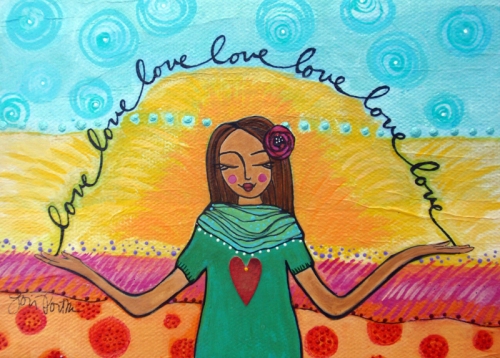
I allow the feeling to grow and expand until I realise what it is. My heart is open. And that’s okay.

withanopenheart.org
withanopenheart.org

The Work Tools

Something happened recently that disappointed me. However, part of me insisted that it wasn’t a big deal, that I was overreacting and that I should get over it and move on. And I did. I mentally high-fived the new easy-going me.

In a conversation this evening, the same issue resurfaces. I receive new information that triggers me all over again.

I end the chat as quickly as I can. I’m just home after a very busy day and I’m starving but I’m too upset to eat.  So I fly up to my room and mutate into a wailing, thumping, tantrumming child.

I’m surprised to see that I’m angry. Anger is an uncomfortable emotion for me. I tell myself that I need to calm down.

I put my phone on silent, sit on my meditation cushion and tap on how I’m feeling (click here for more on EFT – Emotional Freedom Technique).

The anger pours out, as does the hurt. I allow the ego to have its say. What it says and how it speaks sounds so petty and silly that I start laughing. Then the tears return. As does the rage.

Even as I write this, it sounds overdramatic. I don’t want to worry family and friends over something so “trivial”.

That stern, no-nonsense part of me wants to assure you that it really isn’t a big thing. But what message would I be sending my sobbing inner child if I silenced her like that? And so I continue.

google.com

google.com

The tapping uncovers deeper feelings of not being important or special enough. Of being a “psycho”.

I should pretend that I’m fine because if I reveal my real feelings, if I ask for what want, I will surely and immediately become unloved and abandoned. And if that happens, I’ll feel so bad that everything else will be ruined.

With these imaginations, I’ve catapulted myself from a meditation cushion on a fine Friday evening to a near future of doom and failure. I may need another tool…

So I turn to Byron Katie’s transformative process The Work. The first step of The Work is to come up with a statement which is making me feel bad.

The statement I go for is: I’m overreacting. 

I then ask four questions.

The first question is: Is it true? Is it true that I’m overreacting?

Yes, I answer resolutely. Because nothing anyone does should make me feel bad. Only I can make myself bad. So I am overreacting. I should be zen at all times.

The second question is: Can you absolutely know that it’s true?

Again I respond with a Yes because “I should know better than to react this way”. However, I also know that a No to this question would move The Work along nicely.

Once I give myself permission to say that No, maybe I’m not overreacting, the reasons for why I’m feeling this way become clear. No wonder you’re upset, I comfort my poor inner child. There, there.

Then for question number three: How do you react, what happens when you believe that thought?

When I believe that I’m overreacting, I reject myself. I tell myself that I shouldn’t feel the way I’m feeling. I don’t have a right to speak up. My needs aren’t as important as the needs of others. And if I act like they are, those other people will become angry and leave.

The fourth question is: Who would you be without the thought?

If I didn’t have the thought I’m overreacting, if I couldn’t have it, I wouldn’t doubt myself so much. I’d be clearer about my needs. I’d know what I want and what I deserve. I wouldn’t beat up on myself and I wouldn’t feel bad for feeling bad. I’d love myself.

This year, I promised myself something powerful, something life-changing:

I will not abandon myself any more.

This evening, in spite of the pain, I refuse to turn my back on myself. I give myself some much-needed, much-appreciated love.

Regarding the situation, I don’t know yet what the next step is. But maybe acknowledging how I’m feeling, getting to the root of these emotions, seeing that I’m as deserving as anyone else, and loving myself throughout is enough.

OLYMPUS DIGITAL CAMERA

OLYMPUS DIGITAL CAMERA

Little Camino

The past month has been weighed down with money worries, career anxiety, fear for the future and feelings of insecurity. This in turn has had an effect on my self-esteem; how I see myself and how I feel when I’m with others.

The main outcome of a much-needed business coaching session this week was that I need to love myself. And yesterday, I had another revelation.

I’ve been depending on external factors to make me feel okay. I’ll be good enough if and when… I’ll relax when I’m earning more money. I’ll be worthy when I have a flourishing business. I’ll feel secure when my boyfriend does and says all the right things.

However, the reverse should be true. I need to feel good first, anyway, irrespective of anything or anyone.

I have to love myself just because. I must stop placing conditions on my self-acceptance.

And I definitely need to stop waiting for someone else to make me feel good. Because that strategy is destined to fail. Catastrophically.

It’s guaranteed to foster pressure, disappointment and resentment. Feelings become extremely precarious. One action, one word, one thought has the power to tear everything asunder.

What I want to do now is come back to me. That creative, happy individual who knows herself, and who has a full and balanced life with work and friends and hobbies. Who now also has a boyfriend who’s gorgeous and good and full of love and enthusiasm.

But just because I’m now in a relationship doesn’t mean I should lose myself in it. An intimate relationship is actually an opportunity to find myself more deeply than ever before.

I need to live my life. Do the things that give me energy and inspiration. Be there for myself.

I have to stop abandoning myself whenever things go “wrong”. I must remember my worth, see my light, and know that I’m deserving of love and all the good things in life. I need to focus on all the positives that are right there in front of me.

Today is Thursday and I have the day off. Part of me feels ashamed that I’m not busier, that I’m not a part of “normal” working society. Then I remember that I have to stop rejecting myself.

“What’s the most loving thing I could do for myself today,” I ask.

An image of walking in nature flashes before me.

“The sea,” I think excitedly.

“Healthy, delicious food and coffee. And a good book,” I add.

I’ve come up with the perfect recipe: I’ll hike along the coastline from Bray to Greystones, have lunch in one of my favourite restaurants The Happy Pear, then wander back to Bray.

IMG_7281

Most “normal” people work on a Thursday so I go alone. And that’s kind of perfect. My very own mini-Camino.

I don’t listen to music and I put my phone on silent. The weather goes from windy to sunny to rainy.

As I walk, I start thinking. Then I realise that I’m feeling bad. I observe this with interest.

Nothing has actually happened in the here and now and I’ve still managed to make myself feel bad. When instead I could be enjoying the beautiful views of aquamarine waters leaning into the horizon, mountain and birds and yellow furze. I could be breathing in the fresh air. Appreciating this time, this peace, this space…

IMG_7279

So today I choose to come back to me, to stay with me, to love myself and to make myself happy. Because when I’m present to myself in this moment all is right in my world.

Today I take this big lesson from my little Camino back to my working life and to my romantic relationship but most importantly to my relationship with myself.

IMG_7278

Images: Author’s Own

Great-Great Advice

I’m going to share with you a brief but worthwhile exercise from Prof Steve Peters’ book The Chimp Paradox: The Mind Management Programme for Confidence, Success and Happiness.

 Imagine you are 100 years old and on your death-bed with one minute left to live. Your great-great-grandchild asks, ‘Before you die, tell me what I should do with my life.’

Pause for a moment and try to immediately and honestly answer this question. You have just one minute.

Answering this question, according to Prof Steve Peters, will identify what is important to you. It is what life is all about for you. It is your ‘Life Force’.

Whatever your advice was for your great-great-grandchild is really the advice you need to hear. If you’re not living by this advice, which is the essence of your existence, you are living a lie.

“Don’t live a lie,” urges Prof Steve Peters because, “it will unsettle you more than anything else.”

My advice for my great-great-grandchild is to: “Be happy and really really live your life.”

So how can one be happy?

On Friday night, I watched a movie called Hector and the Search for Happiness. This uplifting film is about a psychiatrist who takes himself on a journey around the globe to research what makes people happy.

Without giving too much away, Hector discovers that happiness shouldn’t be the end-goal of the things we do. Rather, we should do the things we like to do and then happiness will emerge as a pleasant side-effect.

One of the most common barriers to happiness that Hector diagnoses is the destructive habit of making comparisons. When we believe that others are happier, more successful and better looking than us, we fail to feel content where we are. We ignore all the positives that are right there in front of us, waiting to be appreciated.

It’s simple really. Happiness is a choice. Do the things that bring you happiness, and appreciate and enjoy all that you have and all that you are.

The second part of my message to my great-great-grandchild is to really really live life. Are we not already living our lives seen as we are alive, you ask? Yes, of course we are. But there’s a difference between living and really really living. And I want to really really live my life.

Really really living means getting out there to experience, explore, learn, grow and expand. It means being present to beauty, to nature and to love.

It’s in the sharing and connecting with other human beings and with all living things. It’s in the embracing and supporting. It’s in our tears and in our laughter.

It’s when we dance, sing, hike and swim. It’s in inspiring and being inspired. This for me is really really living.

Am I following my own advice? Am I being happy and really really living? For the most part, yes. Then sometimes, I compare. I think too much. I worry. I complain.

I wish things were different and I turn my back on the abundance that’s right here right now. I shut myself into a safe, boring, compact box and forget that there’s a glimmering world out there and I can do anything. Anything.

And then somehow life reminds me that it wants to be really really lived. And I thoroughly agree.

What advice would you give your great-great grandchild? Are you practising what you preach? If not, listen to yourself. You’re a wise one!

imagesbuddy.com

imagesbuddy.com

I’m Always Here

Mindfulness is a buzz word of the moment. And being present is a recurring theme in my blog posts.

Yesterday however, I realised that there’s an element of resistance in the way I’ve been practising mindfulness. I’ve been using my version of mindfulness to criticise myself and block self-expression.

Living in the now is being present to experience life as it happens. It’s not about dredging up the past or catapulting into the future. It also isn’t about trying to change how things are. Mindfulness means nonresistance.

Mindfulness has certainly enriched my experience of life. It has enabled peace of mind and improved my sleep. And it’s giving me a deeper appreciation of myself, other people and the world around me.

I’ve also become pretty adept at catching myself as I catastrophise a situation. When I worry about what could possibly go wrong, I can quickly bring myself back to the present moment and know that, right now, I’m okay. This potential future I’ve spun dangerously into doesn’t even exist. All that exists is this moment.

Recently however, I’ve been a little hard on myself when I find myself in my head. Get out of there Sharon, I shout. As if my head isn’t part of me.

When I feel excited about something, I immediately shut off that excitement. I tell myself that I’m silly for fantasising. I insist on being present. There’s no place for dreams Sharon, I scold. There is only now.

I convince myself that hope is a dirty word. Where there’s hope, disappointment will follow. 

It’s as if Eckhart Tolle has infiltrated my inner voice and I can hear his disapproval every time I slip into expectation or attachment. Of course, there’s massive wisdom in Eckhart Tolle’s teachings. And mindfulness is a wonderful practise. But what’s important is how we internalise these concepts.

Yesterday, I complained to my Life Coach that I’m not being present when I fancy a guy. I described being alone in my room thinking of a man I like.

The Life Coach asks me what that feels like. “It’s nice,” I answer. “I feel excited. But then, if things don’t work out the way I’d hoped, I feel so disappointed. I’m not being present.” I frown.

“Are you not being present?” he wonders.

Suddenly, I realise that I am being present. I’m actually always present. I’m always here.

I’m aware of myself as I fantasise. I’m aware as I attach hope to someone or something. I’m the witness, the consciousness, that’s observing everything, all of the time.

When I feel disappointed or excited, in love or anxious, it doesn’t mean I’ve taken a step back spiritually. It just means that I’m human. I’m experiencing and learning.

Being present doesn’t eradicate emotion. Mindfulness doesn’t obliterate thought.

I can be present in my hope and disappointment. I can think thoughts and I can watch myself as I think them. I can allow the inner child to play and get excited. And I can open up to love instead of closing myself off for fear of losing myself.

Mindfulness isn’t about being perfect and feeling zen all the time. It’s about being present to everything exactly as it is. It’s about observing and accepting.

With this new understanding, I feel relieved. I feel looser. I give myself permission to be a human being with wants, needs and desires. I allow myself to feel, to play and to love.

This frees me up to recognise myself as something bigger also. The witness who sees everything and doesn’t judge or criticise. And so I can allow all that is and be as I am.

meditationandmindfulnessforchildren.blogspot.ie

meditationandmindfulnessforchildren.blogspot.ie

Flow

Tonight at an Amber Run gig, I watch as the band becomes immersed in playing. There’s something riveting about witnessing other people express their creativity and passion. It’s exciting to be invited to share the experience.

The vibration of the music pulses through my body. The beat of the drums pulls me in and spurs me on. My hips begin to sway. I raise my arms and close my eyes.

The music moves in me and expresses itself through me. I’m not thinking about how I should dance. And I’m not looking at what other people around me are doing. I’m perfectly happy with myself in the enjoyment of this moment.

Suddenly, I realise that the same concept holds true for life. When we’re present to the now, we’re in the flow. We don’t have to worry about how a thing will unfold. Because when we let go and allow, unfold it will. Beautifully so.

We are the instruments through which life happens. We are the consciousness that sees life happening. And we are life.

A bombshell of awareness and connection implodes and explodes and ripples into infinity. I stand for a while in blissful understanding. Then I smile and rejoin the dance.

To Let It Be

I turned to my friend and announced: “Resistance is what causes most of our suffering.”

This was off the back of a weekend spent in bed, sick and alone, while the sun shone, radio DJs played dance music to prepare us all for a fun Saturday night out, and my Facebook friends posted pictures of forest walks and ice creams in Dun Laoghaire.

I knew I was feeling sorry for myself. And I knew I had a lot to be thankful for. I wasn’t battling cancer. I hadn’t lost my home to a hurricane. And I wasn’t counting pennies to see if I’d be able to put food on the table.

But I was sick. And the weekend blazed sunnily through the windows. And there were no more dark chocolate covered rice cakes in the house.

And I was face-slappingly, heartbreakingly alone.

The thing is, I could have asked for help. In fact, one friend asked me if I needed anything. I replied honestly that I didn’t. There was nothing that I needed. And I didn’t want anyone to have to cancel their plans for me. I wanted people to be with me because they wanted to be there.

So I spent two days at home alone. Between sleeping, blowing my nose and weeping over my aloneness, I delved into Cheryl Strayed’s wonderful book Wild.

Cheryl had gone through some really tough times. Her father was abusive and her mother died of cancer. After Cheryl’s marriage broke down due to her infidelities and use of heroin, Cheryl took on an extraordinary journey in order to become the woman her mother saw in her. Cheryl hiked over a thousand miles alone on the epic Pacific Crest Trail.

“I felt more alone than anyone in the whole wide world,” Cheryl admitted. Later, she reasoned: “Maybe I was more alone than anyone in the whole wide world. Maybe that was okay.”

I lay in bed reading but it felt like I joined Cheryl as she sweated up mountains, grew blisters, lost toenails, and crossed paths with deer, bears and rattlesnakes. I walked alongside her as she raged into the wilderness, carrying a giant rucksack which she aptly named Monster. 

Before Cheryl set off on this amazing trek, somebody told her that the father’s job is to teach his children how to be warriors, “to give them the confidence to get on the horse and ride into battle when it’s necessary to do so.” She said that if you don’t get that from your father, you have to teach yourself. This woman predicted:

“There will come a time when you’ll need to get on your horse and ride into battle and you’re going to hesitate. You’re going to falter. To heal the wound your father made, you’re going to have to get on that horse and ride into battle like a warrior.”

I could relate to the burden Cheryl bent beneath. As she emptied a lifetime of sadness and anger into the wild, I too allowed myself to heal and release. And when Cheryl didn’t think she could go any further, I championed her as she walked on anyway. Her strength and determination humbled me as she completed a miraculous journey back to self. Cheryl finished her memoir with the words:

“How wild it was, to let it be.”

How wild it would be, to let everything be as it is. Without trying to change it. Without resisting what is. Without wishing things were different. Without wondering and worrying, regretting and replaying.

So this evening, I turned to my friend and said:

“Resistance is what causes most of our suffering.” 

And she retorted:

“Thinking is what causes most of our suffering.”

She went on to describe her morning. How she had spent time sweeping up leaves. My friend, like all of us, has plenty to think about, but she didn’t think. She swept.

She watched the leaves swirling in the wind. She felt the brush in her hands. And she listened to the sound of the bristles as she swept.

Tonight in bed, I notice that I am curled up tight, thinking. It hits me that I’ve probably spent most of my life thinking. Not living. Not experiencing. Not being. I’ve spent most of my life in my head. Thinking.

This is my life, I realise. And I want to be present to it. So I resolve to climb out of my head and into my heart. To be in my body. To feel. To experience. To live. To be present. To be open. To simply be.

A vision of my friend sweeping leaves floats into my consciousness. I relax into the bed. I can almost hear the bristles flicking onto the pathway, as the leaves dance in disobedience.

How wild it would be, to let it be.

weheartit.com

weheartit.com

Whirlwind

The last couple of months have been challenging. A whirlwind of emotion has been spinning forcefully within me. The intensity of these feelings has scared me. I’ve fumed with anger, cracked under pressure, retreated in fear, and battled against exhaustion.

Today, a dear friend sent me this passage written by spiritual teacher and author Jeff Foster:

Your feelings, the energies alive in your body right now, were not ’caused’ by anyone else, and nobody else can take them away.

Nobody else is responsible for your feelings. This realisation can end the blame game once and for all, and leave you standing in your true place of power – the present moment.

Making others responsible for how we feel is the beginning of all violence, both internal and external, all conflict between people, and ultimately all wars between nations.

Let others off the hook. Honour what is alive in you right now. Learn to hold your own feelings like beloved children, however intensely they burn and scream for attention. Celebrate the aliveness in your hurt, the vibrancy of your disappointment, the electricity of your sadness. Kneel before the power in your anger, honour its burning creativity.

From this place of deep acceptance, you do not become weak and passive. Quite the opposite. You simply enter the world from a place of nonviolence, and therefore immense creative power, and you are open to the possibility of deep listening, honest dialogue, and unexpected change.

In suffering you become small. In love, anything is possible.

Of course, I knew these words were true. But I also felt strangely annoyed by them. Because I can’t hold anybody else responsible for how I’m feeling. I am not a victim.

Blaming other people or situations may seem like the easy option. It can be comforting to be able to vent to a friend. And it can feel nice to have somebody take your side, bestow you with sympathy, and agree that the other person is wrong. After all, the ego loves to be right.

I had convinced myself that I can’t be at peace until this problem is resolved. That I can’t be happy unless he/she changes. And that I can’t go after what I want in life when I’m trapped by this situation. Hip-high in resistance, I’ve been wading against the flow of life.

However, today’s message has hit home for me. I’ve realised that if I keep raging and complaining, I’ll only be stoking the fires of this energy. I’ll become a casualty of my ego. A slave to circumstance.

Tonight, as I lay my head on the pillow, thoughts of my current predicament come to mind. A swirl of emotion begins to rise up in me. Then, I remember Jeff Foster’s words. Blame nobody.

There may be a whirlwind howling right outside my door. But I am not the whirlwind. And I am not in the whirlwind. I can see it and hear it and it scares me senseless on occasion. But it’s not to blame. It’s a whirlwind. And whirlwinds do as whirlwinds do.

And when the whirlwind spins a destructive path across my world, I’ll join the dance. When it rips things apart and flings them aside, I’ll bow down in gratitude. Because those things to which I’ve formed deep attachments actually need to be destroyed.

So I close my eyes and listen to it howl.

weheartit,com

weheartit.com

No More Drama

These past few days, I’ve been questioning whether I’m holding the belief that good things don’t last. It’s like I dare not presume that it’ll all work out. I’ve been almost expecting things to go wrong.

I certainly don’t want to think this way and I’m afraid that this type of thinking will turn out to be a self-fulfilling prophecy.

But how do I shake such a belief? On the one hand, I’ve managed to become much more positive in many areas of my life. I often go back to the mantra: If one can, everyone can. But I haven’t yet integrated this optimism into all aspects of my life.

As I drive to work today, I tell myself that I’m going to have to shift this. And soon. But how? Do I need to do more tapping and thinking? Should I book in with an energy therapist or a Life Coach?

And then it dawns on me. I don’t have to do anything at all. I just have to stay present. It’s so simple that I might actually have to stop struggling.

What would I do with all the time and energy if I’m not worrying, resisting and analysing? I might have nothing left to write about.

Earlier today, I was speaking to someone about setting up a mindfulness evening. I remarked: “Some people might find the idea of a mindfulness evening boring. We’re so addicted to drama.”

And we are. We get caught up in the highs and lows of life. We love to complain and gossip, fantasise and catastrophise, daydream and reminisce. The thought of sitting in meditation and being present, without constantly narrating or being entertained by our loquacious imaginations, isn’t all that appealing.

My friend told me how beneficial he finds practising mindfulness. He pointed out that the more we sit in meditation, the more automatic mindfulness becomes in our day-to-day lives. It’s no longer such an effort to stay present. It just is. And we just are. He adds:

“And one day, a cup of tea is enough to bring you into total presence.”

I thank him for this beautiful reminder, then go right back to trying to decide what to do tonight. Should I stay in or go to that party? If I go out, will I enjoy it? Will I be too tired at class tomorrow?

I listen to this internal dialogue and bring myself back to the present. I don’t have to decide anything right now. I can see what I feel like doing when it’s time to do it. And I can enjoy this moment because I’m in it.

It really is that easy. No fuss. Just presence.

Well, that was an anti-climax.

unrealitymag.com

unrealitymag.com

What Happens to This Moment?

It is a beautiful day. My companion and I stroll through the woods, picking shamrocks and blackberries. We touch the thick trunks of towering trees, admire the hawthorn, and sniff purple lupine and yellow furze.

We stand for several minutes, gazing out at a stunning view of the Mourne mountains, the sun on the water, and the unexpected sight of a large round moon in the cornflower sky.

I break the silence and ask, “How present are you?”

He pauses then says: “There are a few ways I can be right now. I could be all about the other person – you. I could be totally present within myself. Or I could be present to myself and to another human being simultaneously. Thank you for reminding me of that.”

Later, we discuss the topic further. My friend recalls a Byron Katie quote:

“The end of suffering is to not project a future even one nanosecond away from now, whether you’re experiencing a terrorist attack or just doing the dishes.”

He adds: “We’re always thinking: ‘What’s next? What’s next?’ And when we’re doing that, what happens to this moment?”

“We’re not there for it,” I respond.

I realise that, even while speaking about presence, I’m catapulting myself out of the present by planning and daydreaming, hoping and worrying, fantasising and catastrophising. I’m stepping ten minutes into the future, leaping into next week and somersaulting over decades.

When I’m doing that, what happens to this moment?

I take a breath deep into my centre, look into his eyes and smile.

Image: Author's Own

Image: Author’s Own