Tag Archives: self-esteem

Other People

Yesterday, I texted a few of my like-minded friends to share my most recent awareness. The importance of other people.

Relationships (with a partner, friends, family, co-workers, acquaintances) accelerate our growth and teach us more about ourselves than all the spiritual retreats, self-help books, and hours of meditation and counselling ever could.

Other people serve as mirrors. They reflect back to us how we feel about ourselves and the beliefs we’re holding about life.

Every single person who enters our lives is there for a reason – to show us all the barriers we’ve placed around ourselves. Once we become aware of these barriers, we can remove them and open ourselves to love.

In Marianne Williamson’s book A Return to Loveshe writes about the two main emotions we experience – love and fear. Fear closes our hearts. Love opens us up to an easier, brighter, more wonderful world.

Up until recently, I had assumed that I preferred to be alone. I’d spend most evenings on my own, reading, writing, and watching TV. I walked alone, jogged alone, cycled alone. I meditated and did yoga alone. I took myself for coffee. I wandered alone in nature and took pictures. I holidayed in the west of Ireland. Alone.

I’m proud of my independence and I’m content in my own company but sometimes a stray pang of loneliness manages to slip through my carefully constructed armour. I realise now that I was confusing strength with a refusal to budge out of my comfort zone.

I really believed that I did better at life when I was single. Romantic relationships seemed to blaze into my world. They were quick and exciting and dangerous.

They were so out of my control that I feared I’d be engulfed in their flames. Then they died out, leaving me to tend to my burns.

I missed the warmth and beauty of relationships but I also felt blessedly relieved to be alone again. Alone, I was in control.

My longest romantic relationship was with my now ex-husband. Everything since then has never made it past the four-month mark.

I led what I thought was a balanced life. I had oceans of time to work on myself. I grow more when I’m single, I convinced myself.

And I’m glad of the time and space I’ve had to heal and to flourish. I agree that one must love oneself and have a full and happy life before one is ready to enter into a healthy relationship.

The thing is, I kept waiting for one (i.e. little old me) to become perfect, conscious and enlightened. I forgot that this life is a journey. And on this arduous yet rewarding adventure, we’re constantly learning, evolving and recalibrating.

It’s nice to share some of that journey with our fellow travellers who can also feel lost and who are also searching for meaning. And there’s more laughter and intimacy to be had on a path walked with more than one set of feet.

feet

After living alone for four years, I now have two housemates. I’m also spending more time with my fabulous friends. And I love meeting new people. How different we are fascinates me. How similar we are humbles me.

I understand now that living involves other people. For what is a life without company, support, affection and passion?

Other people highlight the areas we need to work on so that we can peel off yet another bullet-proof layer. It’s so much lighter and freer to let go of these heavy burdens that weigh us down and close us off. But it’s scary to be so exposed, so vulnerable.

I know that I have difficulty letting people in. Asking for help and believing I deserve to have my needs met is a challenge. But it’s a challenge I’m willing to accept.

Communication is also an area I’m working on. Recently, I detected a pattern of mine. When the going gets tough, my instinct is to bolt. To get out that door and never come back. But where’s the maturity in that? Where’s the learning, the growing, the compassion? Where is the love?

Other people have an amazingly frustrating knack of triggering the emotional reactions that I used to resist and get angry about. Now, when someone does or says something that provokes me to feel hurt, annoyed or defensive, I remember to breathe into it.

I feel grateful for this issue that I need to deal with. I look at my feelings about the incident, which leads to an understanding of why I’m feeling the way I do. Then, I let go and bring myself back to the present moment.

This is a very new practise for me, by the way, but it’s a revelation! I highly recommend it.

Today, I’m more open than ever before. This translates into a heightened enjoyment of life, a deeper appreciation of beauty, and more fun, peace and connection.

I am, thankfully and in Melody Beattie’s words, codependent no more. Nor am I locked in a distant land of me, myself and I.

I’m travelling on this awe-inspiring path called life. And it’s rich with billions of souls from whom I can learn so much, and with whom I can share a luminous journey.

hammock

Images: Favim.com

To Let It Be

I turned to my friend and announced: “Resistance is what causes most of our suffering.”

This was off the back of a weekend spent in bed, sick and alone, while the sun shone, radio DJs played dance music to prepare us all for a fun Saturday night out, and my Facebook friends posted pictures of forest walks and ice creams in Dun Laoghaire.

I knew I was feeling sorry for myself. And I knew I had a lot to be thankful for. I wasn’t battling cancer. I hadn’t lost my home to a hurricane. And I wasn’t counting pennies to see if I’d be able to put food on the table.

But I was sick. And the weekend blazed sunnily through the windows. And there were no more dark chocolate covered rice cakes in the house.

And I was face-slappingly, heartbreakingly alone.

The thing is, I could have asked for help. In fact, one friend asked me if I needed anything. I replied honestly that I didn’t. There was nothing that I needed. And I didn’t want anyone to have to cancel their plans for me. I wanted people to be with me because they wanted to be there.

So I spent two days at home alone. Between sleeping, blowing my nose and weeping over my aloneness, I delved into Cheryl Strayed’s wonderful book Wild.

Cheryl had gone through some really tough times. Her father was abusive and her mother died of cancer. After Cheryl’s marriage broke down due to her infidelities and use of heroin, Cheryl took on an extraordinary journey in order to become the woman her mother saw in her. Cheryl hiked over a thousand miles alone on the epic Pacific Crest Trail.

“I felt more alone than anyone in the whole wide world,” Cheryl admitted. Later, she reasoned: “Maybe I was more alone than anyone in the whole wide world. Maybe that was okay.”

I lay in bed reading but it felt like I joined Cheryl as she sweated up mountains, grew blisters, lost toenails, and crossed paths with deer, bears and rattlesnakes. I walked alongside her as she raged into the wilderness, carrying a giant rucksack which she aptly named Monster. 

Before Cheryl set off on this amazing trek, somebody told her that the father’s job is to teach his children how to be warriors, “to give them the confidence to get on the horse and ride into battle when it’s necessary to do so.” She said that if you don’t get that from your father, you have to teach yourself. This woman predicted:

“There will come a time when you’ll need to get on your horse and ride into battle and you’re going to hesitate. You’re going to falter. To heal the wound your father made, you’re going to have to get on that horse and ride into battle like a warrior.”

I could relate to the burden Cheryl bent beneath. As she emptied a lifetime of sadness and anger into the wild, I too allowed myself to heal and release. And when Cheryl didn’t think she could go any further, I championed her as she walked on anyway. Her strength and determination humbled me as she completed a miraculous journey back to self. Cheryl finished her memoir with the words:

“How wild it was, to let it be.”

How wild it would be, to let everything be as it is. Without trying to change it. Without resisting what is. Without wishing things were different. Without wondering and worrying, regretting and replaying.

So this evening, I turned to my friend and said:

“Resistance is what causes most of our suffering.” 

And she retorted:

“Thinking is what causes most of our suffering.”

She went on to describe her morning. How she had spent time sweeping up leaves. My friend, like all of us, has plenty to think about, but she didn’t think. She swept.

She watched the leaves swirling in the wind. She felt the brush in her hands. And she listened to the sound of the bristles as she swept.

Tonight in bed, I notice that I am curled up tight, thinking. It hits me that I’ve probably spent most of my life thinking. Not living. Not experiencing. Not being. I’ve spent most of my life in my head. Thinking.

This is my life, I realise. And I want to be present to it. So I resolve to climb out of my head and into my heart. To be in my body. To feel. To experience. To live. To be present. To be open. To simply be.

A vision of my friend sweeping leaves floats into my consciousness. I relax into the bed. I can almost hear the bristles flicking onto the pathway, as the leaves dance in disobedience.

How wild it would be, to let it be.

weheartit.com

weheartit.com

Fairy Story

Last night, as I flicked through an old copy book in search of an empty page, I stumbled upon a Fairy Story that I’d been asked to write as part of an Inner Child workshop I’d taken part in a while back. Here it is…

Once upon a time, there was a beautiful, perfect little princess called Sharabella. There was something about this girl that shone brilliantly from within. You could see it in the sparkle of her eyes and her fun-loving laugh.

People loved to be around Sharabella. She didn’t even have to do anything. People just felt better after having been in her presence.

This was Princess Sharabella’s magic gift. She simply had to be herself and others were healed. All was well in this magical kingdom.

However, there came a time when Princess Sharabella was needed in a very different kingdom. A kingdom that was full of pain, sadness and suffering. The Powers That Be decided that Princess Sharabella could help transform this kingdom’s pain into love and beauty. 

Sharabella landed on this kingdom filled with peace and optimism. What Princess Sharabella hadn’t counted on was how much skepticism and resistance she’d face. 

Slowly over time, poor Sharabella began to doubt her magic powers. She started to wonder if she really was as perfect and beautiful as she’d once believed. 

It was such a struggle trying to change these people’s way of looking at things so Sharabella began to shut up and shut down.

Her beautiful light dimmed more and more over the years until one day, when The Powers That Be paid this dark, gloomy kingdom a visit, they no longer recognised beautiful Princess Sharabella. 

Sharabella was tired, grey and depressed. When The Powers That Be finally realised who she was, they asked her what had happened. 

At first, Princess Sharabella didn’t know what they were talking about. “This is who I am now,” she stated gruffly. “I’m ugly and useless and this kingdom would be better off without me.”

“But once upon a time, you were Princess Sharabella – the most beautiful, luminous, perfect creature, with the gift of healing others with your mere presence,” The Powers That Be exclaimed.

Nobody realised that an outsider had overheard their conversation. A crippled old lady had witnessed the whole exchange. She was moved to tears by Sharabella’s despondence. If a Princess despised herself so much, what hope did the rest of them have?

The old lady couldn’t help but speak out. “Excuse me,” she interrupted as she leaned on her walking cane. “I’m confused. I have to ask: What is a Princess doing in this horrible kingdom? This place is filled with hate and destruction. Us citizens know no different. We’re used to this life. But you? I urge you to get out. Save yourself, while you still can!”

The lady trembled with urgency while The Powers That Be stood there, uncertain as to how to proceed.

Slowly, Sharabella looked up, her eyes brimming with tears. She started to sob – loud, uncontrollable gulps of emotion.

As she cried, her cloudy, grey eyes turned to bright blue. Her ashen complexion became rosy pink. A brilliant light flickered, then started to beam out with such magnificence that everybody dropped to their knees in awe.

In this moment, Sharabella realised that she was not the ugly, depressed woman she had grown to believe she was. She remembered that she was the beautiful, perfect Princess that was her birthright. It had simply become unclear and difficult to express in a kingdom that had never accepted such perfection.

If she could heal people in her old kingdom, she knew she could do it here too. But not if she continued believing that she was ugly and worthless.

Suddenly the old lady, inspired by what she had just witnessed, ran away, excited to tell her friends and family what had just happened. 

“She forgot her walking cane,” Sharabella said. And Princess Sharabella and The Powers That Be laughed and laughed.

weheartit.com

weheartit.com

The Fear

One of the biggest things I’ve struggled with over my lifetime is fear. Over the past few days, I’ve examined this fear and I’ve discovered that it has many, many layers.

There is fear of making mistakes. Fear of doing it wrong. Fear of failure. Fear of getting into trouble. Fear of criticism, disapproval and rejection. Fear of my own feelings. Even fear of happiness in case it were to disappear.

Fear of not being good enough. Fear of not being talented enough, competent enough, confident enough, pretty enough, slim enough, and the list goes on…

Fear of losing hope. And fear of having hope because I’m bound to destroy it.

As I shower this morning, I realise what’s really lurking behind all this fear. It’s fear of being found out. Found out to be stupid, incapable, ugly, unlovable.

And so this fear has prevented me from going for jobs, moving abroad, writing a book, staying in relationships, opening up to friends, and telling people that I like them. In short, fear has stopped me from putting myself out there.

Once I make this discovery, I can logic it. What is it about stepping out that I’m so afraid of? That people will discover that I’m human? Scared? Imperfect?

Aren’t these the things that I love and admire in other people? Don’t we feel more connected with other human beings when we realise that we’re all the same? Real and brave and frightened?

If I can accept others for how they are, why do I resist doing the same for myself? Why are my standards and expectations for myself so ridiculously high? Is it because I don’t like myself enough or is it because I like myself so much that I want to be the best that I can be? Interesting because this desire is actually blocking me from doing just that.

Over the Christmas, I read Marianne Williamson’s A Return to Love: Reflections on the Principles of A Course in Miracles. Once I delved into the first chapter, I was hooked. Marianne speaks about being paralysed with terror. She writes:

“You’d think we have some compassion for ourselves, bound up in emotional chains the way we are, but we don’t. We’re just disgusted with ourselves, because we think we should be better by now. Sometimes we make the mistake of thinking other people don’t have as much fear as we do, which only makes us more afraid. Maybe they know something we don’t know. Maybe we’re missing a chromosome.”

This really resonated with me. I forget that other people feel fear too. Everybody does. We just don’t hear about it all that much. We think that other people just get on with it. They do and they grow and they succeed.

And I compare myself unfavourably with the whole human race. I neglect to focus on my own courage and achievements, which are many.

I dismiss my own journey and instead listen to the family members and neighbours as they comment on So-and-so’s flourishing business and Thingymajig’s promotion and new home and Yer-one-down-the-road’s wonderful partner and family.

“They’re doing so well”, they gush. And I hate myself a little more. I see other people’s highlight reels on Facebook and I wince in self-judgement.

Last night, I lay in bed reading Oprah Winfrey’s lovely book What I Know For Sure when I had an Aha moment. Oprah speaks about her fear of seeming arrogant. She writes:

“In some ways, even my weight was my apology to the world – my way of saying, ‘See, I really don’t think I’m better than you.'”

When I was younger, I was teased for being “posh” and using big words. I was also teased for having a rather large bosom for a 13-year-old. And I was beaten up because a girl’s boyfriend fancied me.

After those experiences, I was careful with my language and I tried not to appear full of myself. I changed the way I behaved depending on the group of people I was with. I didn’t flirt. And I made sure not to do anything too different so that I could avoid unwanted attention.

When other people were miserable, I downplayed my contentment and instead broadcast my difficulties. You see, I’d say. I’m not a threat. So you can like me.

Now that I understand where all this fear comes from, I have a choice. I choose to no longer allow fear to immobilise me. I want to take risks and move forwards and flourish. And I understand that I do love myself. I’ve just been confused about how to show myself this love.

From now on, I’ll love myself when I have the courage to shine. I’ll love myself when I’m gasping with fear. I’ll love myself when I do. And I’ll love myself when I am.

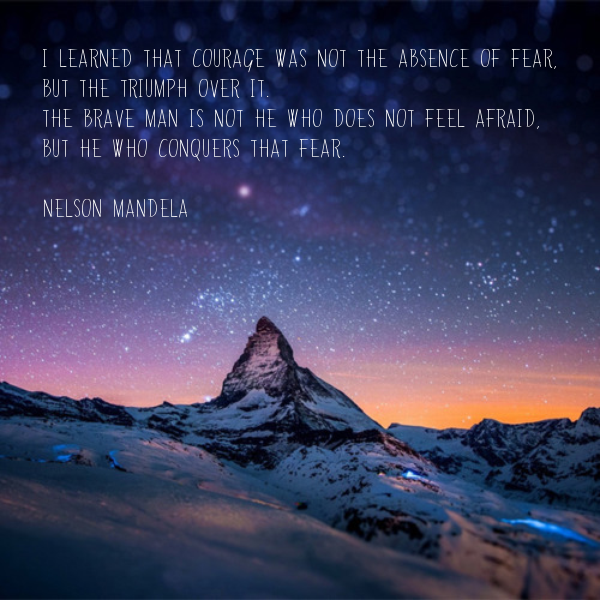
The trick is to understand that we all feel fear. Our bravery lies in our ability to push forth anyway. In Oprah Winfrey’s words:

“Sometimes moving on terrified me. But it always taught me that the true meaning of courage is to be afraid, and then, with your knees knocking, to step out anyway.”

keepcalm-o-matic.co.uk

keepcalm-o-matic.co.uk

Testing, testing

I’ve noticed that, when things are going well and I think I’ve learned so much, I get tested on it. As much as I’d rather the good times keep rolling, these tests do push me further along on my journey and make me appreciate the view all the more once I’ve achieved the arduous climb.

In the past few weeks, I’ve experienced some wonderful opportunities that have filled me with anxiety. Despite the temptation to remain tucked tight in my comfort zone, I’ve risen to these challenges with courage and I’ve been able to acknowledge my determination and skills.

Over the past while, I’ve also been faced with a number of not so pleasant challenges. These circumstances have demonstrated how swiftly I can be blown out of the present moment, how easily my enjoyment of life is snatched away, and how much power I hand over to other people and things.

On the upside, these challenges have highlighted how different I am now, how much more I value myself, how aware I am of my own reactions, how I refuse to be sucked into the drama, and how quickly I can bring myself back.

A Hay House Radio presenter suggests viewing a painful situation not as something to avoid and be frustrated about but as an opportunity for growth.

It may be difficult to see the positive in current tribulations so imagine that you can see into the future. In the big picture, this trialling time will probably work as a catalyst for change or it will be used as a stepping stone towards your highest good.

Are you facing any challenges right now? If you’re human, you very likely are. What is this challenge showing you? Is it presenting you with an opportunity for growth? If so, lean into it. Good luck!

Listen

As I climb into bed, various opinions and pieces of advice that people have given me over the years flash into my mind. I recall their musings on my life and on what I should and shouldn’t be doing.

After bulldozing in with their tuppence worth, these supposed do-gooders continued on with their lives without a second thought. Meanwhile, I attached more value to their throwaway comments than to my own lifetime experience of being me.

I’ve spent long enough caring about how others perceive me. I’ve winced at their judgements, flinched at their criticism, basked in their compliments, and hoped for their approval.

Before taking action, I presumed how other people would react. This ineffective technique of mind-reading actually influenced how I was feeling and the choices I made.

Now in my thirty-fifth year on this planet, I’m finally getting sense. I understand that anything anyone says is coming from their perspective. People dish out suggestions that are based on a minuscule snapshot of my life. And even that tiny glimpse is filtered through the lens of their own history and beliefs.

Last night, as I walked alongside my sister, I was tempted to ask for her thoughts on something I’d spoken about earlier. But I realised that I would be doing it out of habit. It didn’t really matter what she thought about this subject. Getting her to advise me would be a waste of her energy because I knew that I would go with my gut anyway. And I mightn’t even want to hear what she had to say.

Not many people enjoy being told what to do. Nobody likes feeling judged either. And how can anyone know with absolute certainty what’s right for another person?  By doling out our opinions and “friendly” advice, we run the risk of blocking the flow of communication.

All we have to do is be there for one another. We don’t have to stress about giving the right guidance. What a relief not to have to be responsible for coming up with the answers or fixing everyone else’s problems.

Instead of handing out answers, start asking questions. This will facilitate lateral thinking, which will enable the other person to open up to previously unexplored options.

Support your friends/family/partners/clients in whatever course of action they decide to take. Listen to them. And more importantly, really hear what they’re expressing.

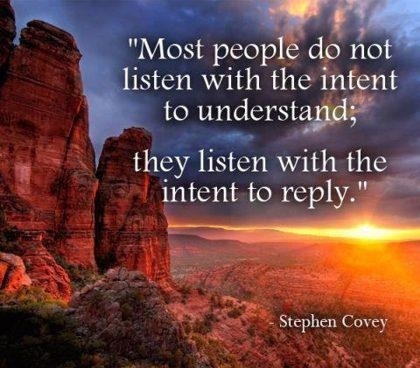
All we really want is for someone to just be with us and really hear what it is we’re saying. Because when we are heard, we feel understood. And when we feel understood by another human being, that is the beauty of true connection.

quoteswave.com

quoteswave.com

Let’s Agree to Disagree

It has just struck me how I’ve been struggling for as long as I can remember to be perfect. I want to look perfect. I have to do everything perfectly. I’d love to be in the perfect relationship. I need to feel perfect.

But what is perfect? Who decides what perfect looks like? What’s perfect to me might not be perfect to you and vice versa.

As Don Miguel Ruiz demonstrates in his brilliant book The Four Agreementswe, as a society, have made certain agreements. Agreements on how things should be. And if any of us stray away from these agreements, if one of us dares to be different, there are consequences.

We fear being ostracised, disapproved of, and rejected. So we attempt to bundle the enormity of our spirit into a perfectly suffocating box.

And the most unbelievable part is that these agreements were probably decided before we were even born or at least before we had the sense and intelligence to realise what we were signing up for.

We were given a name and instructed how to behave, how to look, what to do, and how to be. And if we moved away from any of those specifications, we were shown, directly, or worse, indirectly – through withdrawal of love and affection – that to be unique was not okay.

Well hey, I’ve got some liberating news to share. It is okay to be yourself. It’s more than okay. The world needs free spirits, different thinkers and adventurous trailblazers. Let’s tear up those obsolete agreements and allow our individual lights to shine.

I am no longer going to strive for perfection because it doesn’t exist. Perfection is an illusion that I blindly agreed to pursue. But now that I can see clearly, I am choosing to disagree. Who’s with me?

real

Instalove

I was describing my new Christmas pyjamas to someone recently when she asked if I’d taken a photo of myself in said pyjamas and posted it on Instagram or Facebook because, she continued: “So-and-so* tells me you’ve been taking a lot of photos of yourself lately.” *Name has been changed to protect anonymity.

I felt annoyed and embarrassed. Because (a): People were talking about me behind my back. And (b): If they were saying it, how many others were? I worried that I’d appear vain or insecure or both.

I chided myself for getting upset over such a trivial matter. Then, I remembered that I don’t give out to myself any more. I reminded myself that I’m human and I still care what others think of me, though less so than before. Thankfully!

I realised that I don’t have to take the comment in a negative way. It doesn’t mean that these people don’t like me. It was a simple observation. Like: “Sheesh Sharon, you’ve been going on a lot of cycles lately!” or “Wow, you drank a lot of water today.”

Clearly, this has stirred something in me. Something that was already there. It just took this comment to shine a light on it. So I hacked into my two earlier points and came up with the following:

(a) I don’t want people to speak about me behind my back. Is that true? Well, I’d quite like it actually if they were talking about how talented and gorgeous I am. And if they’re saying something negative, would I rather they say it to my face? Not really.

(b) I was worrying about people thinking I was vain or insecure. The irony is that I was being vain and insecure by worrying about being seen as vain and insecure.

weheartit.com

weheartit.com

These days, many girls (and guys for that matter) are taking selfies with their cellphones. And with the prevalence of amazing App Instagram, we can paint ourselves in fantastically forgiving filters.

The thing is, I love beautiful things. I enjoy taking pictures of them and I delight in Instagramming them, then sharing them via social media. I actually take plenty more pictures of nature than I do of myself. So why is it more acceptable to upload shots of flowers and trees than profiles of your fabulous self?

It’s because you’ll be seen as “up yourself” or “too big for your boots”. The confidence of the Americans is often perceived as brash and annoying across the Atlantic. It’s a rather Irish trait to not want to be seen as “getting ahead of yourself”. Modesty is our currency. No wonder we’re broke.

All the personal development books tell us to love ourselves but sure that’s a daft notion to us Irish. “That wan really loves herself” is a horrific insult round these parts. And we’d feel mad foolish speaking affirmations into a mirror!

I distinctly remember, as a very small child, being read a lovely fairy-tale. The heroine of the story was a beautiful young thing who didn’t know how beautiful she was. This only made her more beautiful to all who witnessed her shy beauty. However, she believed she was a dreadful, lowly creature. She lived her life this way until, one day, a dashing prince set his eyes on her and fell head over heels in love, much to her total astonishment. And, of course, they lived happily ever after. The end.

At the tender age of five years, I decided that I would be just like that fictional doormat of a character. To think of myself as less than was surely the right way to do it. I can’t logic this out for you now as I can’t quite get back into the mindset of that tiny child. But it’s no wonder it’s been a long, challenging process turning it all around.

The fact that I now see myself or my new haircut or the bright orange of the scarf I’m wearing in the same admiring light as the autumn leaves or the ocean or that delicious cupcake I’m about to scoff is wonderful.

I don’t think these people did anything wrong for making such a comment. A comment is just a comment. It is my reaction to it that matters. I looked at my reaction, thanks to the light that was shone upon it, and accepted it.

I’m delighted I’ve come this far. And for me, social media is all about sharing. One day, I’ll want to share with you my latest blog or a stunning piece of music. The next, I’ll post an inspirational quote or a picture I just took of a woman who loves herself.

picasaweb.google.com

picasaweb.google.com

Are You a Pessimist?

Over the years I’ve noticed that any time I get into really bad form, it’s because I’ve started believing the thoughts that are telling me that everything has gone to shit.

I’m lazy and useless. I’ve gained weight. I’m ugly. I’m alone. I’ll never amount to anything.

Recently, I observed that I was slipping into one of those moods. Rather than dwell on it, I switched on an interview with Dr. Joan Borysenko, psychologist and mind-body medicine expert.

I was half-listening as I got ready for bed when I heard Joan speaking about pessimistic thinking. Joan says that you can inherit a pessimistic world view. This type of thinking happens when you lose hope and can’t see a way out of things.

When something bad happens, Joan suggests looking at your explanatory style. How do you explain this negative occurrence to yourself? Martin Seligman put forward the Three Ps of Pessimism. They are as follows:

1. You take things Personally. You blame and even hate yourself. You can see from above how I was telling myself that I was lazy and useless.

2. Your thinking is Pervasive. Nothing in your life is good. Relationships, family, work, body-image: all crap.

3. Permanence. You’re in a mental rut and you can’t imagine that your life could be any different. You feel stuck. I was telling myself that I’d never amount to anything and that I’d always be alone.

This was a revelation to me. I was relieved to realise that I am not alone in this type of thinking. And once I become aware of it, and own it, it immediately loses its grip on me. I can choose the way I think.

Joan suggests disputing what you say to yourself. When you watch your mind and witness your thoughts, you can see that you’re telling yourself a story, one that isn’t true. This creates distance from the thoughts so you can observe and even learn from them.

Joan explains the science behind all of this, which I won’t go into in detail now. Basically, she states that you can change your brain circuitry. Brain plasticity allows for the rewiring of your nervous system. So you don’t have to be stuck with pessimism for the rest of your life.

Joan doesn’t suggest shifting from pessimism to optimism. Rather, she speaks about the benefits of stress-hardy or I-can-do-it thinking, which is more realistic.

Suzanne Kobasa introduced the Three Cs of Stress-Hardy Thinking. They are as follows:

1. The stress-hardy thinker will want to rise to the Challenge.

2. Commitment. The person will stick with the challenge and see it through.

3. Control. The stress-hardy thinker doesn’t try to control the uncontrollable. Instead, they focus on what they can control.

And if you can’t see yourself making the leap into stress-hardy thinking just yet, Joan suggests a few quick and simple tips to calm down your fear responses. Deep breathing, exercise and just a five-minute meditation can be enough to bring you back from your pessimistic thinking.

Do you recognise yourself in any of this? If you get caught in a spiral of pessimism every now and again, don’t beat yourself up. You’re human. But you do have choices. Change your thinking, change your life. Are you up for the challenge?

themebin.com

themebin.com

Gone fishin’

Online dating is becoming more widespread and accepted. If you’re single, you will no doubt be advised to set up an online profile. I’ve heard (and experienced) many heartwarming, hilarious and outrageous stories about the wild, weird and wonderful world of the online dater.

Online dating can be fun and exciting. But it can also be fickle and disappointing. The thing about popular dating website Plenty of Fish is that there are, quite literally, plenty of fish floating around cyberspace. And all these little fishies are hoping to fall hook, line and sinker (sorry, I couldn’t resist) in love or, for many, in lust.

The frustrating and often confusing aspect to online dating is that you could be exchanging flirty emails with a potential partner when he/she suddenly stops replying. You may have even arranged a date only to receive a last-minute cancellation text.

On the upside, there’s so much choice. The flip side is that you have no idea how many other fishies your charmer is chatting up and even simultaneously dating.

If you’re dabbling in online dating and are feeling fed up and let down, why not change tactics? Take all the good stuff on offer and use it to your advantage. Follow these seven tips to make the most of your online experience:

1. Be grateful that there are many interesting, attractive people out there who are single and oh-so-ready to mingle.

Also, give gratitude for t’internet. What a quick, easy way to meet new people. You’ll save yourself time, money and manys the hangover using this method of finding someone.

2. Have fun on your trawling expeditions. Think of your browsing sessions as shopping sprees. And if you happen to make a special connection with somebody, then happy days!

3. Don’t put all your eggs in one basket. It’s not just men who feel the pressure to follow up and settle down. First dates with a stranger can be nerve-racking. Will you fancy them? If not, should you give them a chance anyway? Will they want to meet you again? What if they try to kiss you or attempt to get you into bed? How will your in-laws get on? [Yes. Your mind manages to reach crazy levels of hypothesising if left unchecked.]

Take the pressure and expectation down a notch by mailing lots of different users and going on dozens of dates. It does get easier. And, even if you do like your date, it doesn’t mean you have to marry them. Now’s the time to enjoy and get to know one another. There’ll be plenty of time to get serious.

4. Enjoy meeting new and interesting people. If you stay present on your dates, you’ll see (and enjoy) how magnificent the situation is. Regale your friends and family with hilarious stories. Heck, write a book about it and make some moolah!

5. Give yourself a good pep talk. Eleanor Roosevelt said: “What other people think of me is none of my business.” It really isn’t you, it’s all about them. It only becomes about you when you react a certain way. They don’t know you so they can’t reject you. They may have met someone else more suitable to their current taste. Or you may just not be their type. We all have different preferences, thankfully. It doesn’t mean that you’re not gorgeous, loveable or perfect for your perfect partner. Also, if you think about the big picture, this perceived rejection could have spared you a terrible date or left you open for something better to come your way.

The other day, I had to stand in a long queue. Two toddlers met for the first time. Loudly and excitedly, they shared scooters and hugs and told one another that they were best friends. When one had to part, they cried and wailed. One minute later, a new toddler joined the line. The other child stopped crying, walked right up to the new kid and asked: “Will you be my best fwend?” Moments later, they were playing and laughing enthusiastically. We could learn a lot from kids, eh?

6. And finally, keep living and looking offline too. You could still meet the love of your life in a sweaty nightclub or in the café you’d always daydreamed about. Just because he/she isn’t carrying a banner including their stats and an ‘About Me’ section doesn’t mean they’re not available. Be sociable, live life and have fun. You’re most attractive when you’re happy with your life and who you are. So keep smiling.

weheartit.com

weheartit.com